HY banner

Click here to start trading
Showing posts with label Sarawak. Show all posts

Thursday, November 1, 2012

Annah Rais Bidayuh Longhouse


The Annah Rais Longhouse is an authentic Bidayuh Longhouse located in the hill slope region outside of Kuching. This Bidayuh village is accessible by road and it is the nearest native village from the city. Take this longhouse tour and expect to enjoy the encompassing beauty of the scenery around the longhouse.
The Bidayuhs are mainly farmers and they plant crops like corn, rice, pepper, cocoa and local vegetables for their own consumption as well as for sales at the local city markets.
The chief of the longhouse is called the "Tuai Rumah". They are mostly very hospitable and friendly.
The Longhouse is about two hours drive from Kuching towards the Indonesian border. The interior is very spacious, perfect to accommodate families. It is located in very beautiful surroundings. It can be visited on an arranged tour, which usually includes a traditional welcome by the residents. Alternatively, it can be visited individually. A small fee has to be paid before entering.
The ladies performing a traditional dance
Welcoming the guest

Headhunters trophies

The clear stream by the longhouse

Activities that you can do here.

Monday, October 29, 2012

Kubah National Park


Almost every visitor to Kuching has seen Kubah National Park, whether they realise it or not. This massive sandstone ridge with its three mountain peaks – the 911m high Gunung Serapi and the slightly smaller Gunung Selang and Gunung Sendok – is clearly visible from the Kuching Waterfront. Situated only 22 kilometres from Kuching, Kubah is not only the most visible but also one of the most accessible of Sarawak’s National Parks.
Kubah was established in 1989 because of its exceptionally rich plant life, and only opened to the public in 1995. The Park covers an area of 2,230 hectares, and comprises the heavily forested slopes and ridges of the Serapi range. At heights of between 150-450 metres, Kubah’s soft sandstone is punctuated with bands of hardened limestone which have created a number of beautiful waterfalls.
Kubah’s most famous feature is its palms. Almost a hundred different palm species can be found in an area of just over 22 sq km, making Kubah probably the richest palm habitat for its size anywhere in the world. But Kubah’s palms are not only abundant – they are also historically and ecologically important. Many of Kubah’s palms were first described by the great Italian botanist Odoardo Beccari (1843-1920), who spent 3 years in Sarawak from 1865 to 1868, and recorded his findings and experiences in a remarkable book, Wanderings in the Great Forests of Borneo.
As well as its palms, Kubah has many other striking attractions; its spectacular primary rainforest, its rich selection of orchids and ferns, and its crystal clear jungle streams, waterfalls and bathing areas, to name just a few. The rainforest scenery has even caught the attention of Hollywood; in 1987 Gunung Serapi was the principal film location for Farewell to the King starring Nick Nolte - as you approach the entrance to the park HQ you will see the film set to the right. The Sleeping Dictionary, starring Jessica Alba, was shot in the nearby forest foothills adjacent to the park, which provided a stunning backdrop for the film.
The forest at Kubah is mixed dipterocarp, with small areas of scrub forest and isolated patches of kerangas. This rich forest, the park’s proximity to the coastline and its general terrain all ensure that Kubah is home to a variety of wildlife, including bearded pigs, 50-plus bird species (including argus pheasants and black hornbills), sambar deer, mouse deer, civets, porcupines, squirrels and numerous species of amphibians and reptiles.

Wednesday, October 24, 2012

Orang Utan...the man of the jungle.


The orang utan (pongo pygmaeus) is found in the rainforests of Malaysian Borneo (Sarawak and Sabah), Indonesian Borneo (Kalimantan) and North Sumatra. It is one of the world’s largest primates, and is almost completely arboreal (tree living). The word “orang” is Malay for “person” whilst “utan” is derived from “hutan” meaning forest. Thus, orang utan literally translates as “person of the forest”.

A mature male has large check pads and a pendulous throat sac. Adult males can reach a height of 150 cm (5 ft), weigh up to 100 kg (220lbs) and have an arm span of 240 cm (8 ft). Females are about three quarters of the height and half the weight of the males. Both sexes are covered with long reddish hair. Orang utan have a low reproductive rate, females usually giving birth to a single infant once every 7-8 years. Females reach sexual maturity at 12 years of age but generally don’t have their first offspring until two or three years later. Males reach sexual maturity at 15 but their cheek pads may not fully develop until a few years later. The life expectancy of orang utan in the wild is unknown but is thought to be less than in captivity, where some have lived to over 50 years of age.

Orang utan are primarily fruit eaters and spend most of the day roaming the forest foraging for food. They are particularly fond of wild figs and the pungent smelling durian. Although fruit is their most important source of food, they also feed on young leaves, insects, bark, flowers, eggs and small lizards. Each individual builds a new nest each night, a safe resting place 12-18 metres (40-60 ft) up in the roof of the forest.

Wild orang utan are generally solitary. However, adolescents often gather in pairs and females occasionally form temporary groups of four or five. This rather lonely existence stems both from the relative scarcity of food in the rainforest and from a lack of predators. A mature adult roams a vast area of forest every day in order to find enough food to satisfy its healthy appetite. Its huge size also eliminates the need for ‘group defence’.

The orang utan is an endangered species and is totally protected by law in Malaysia, Indonesia and internationally. Today, there are an estimated 20-27,000 orang utan left in the wild (perhaps 20,000 or so in Borneo and the rest in Sumatra). Deforestation, human encroachment on their habitat, indiscriminate hunting and the live animal trade: all are factors that have contributed to a decline in their numbers. To gain a better understanding of the orang utan and re-introduce rescued animals into the wild, both the Indonesian and Malaysian authorities have set up rehabilitation programmes. Sarawak’s centre at Semenggoh is open to the public so visitors can find out more about these highly intelligent creatures of the rainforest.

Tuesday, October 23, 2012

Bako National Park

Bako National Park, established in 1957, is the oldest national park in Sarawak, eastern Malaysia, on the island of Borneo. It covers an area of 27.27 square kilometres (10.53 sq mi) at the tip of the Muara Tebas peninsula at the mouth of the Bako and Kuching Rivers. It is approximately 40 kilometres (25 mi) by road from Kuching. Millions of years of erosion of the sandstone have created a coastline of steep cliffs, rocky headlands and stretches of white, sandy bays. Wave erosion at the base of the cliffs has carved many of the rocky headlands into fantastically shaped sea arches and seastacks with colored patterns formed by iron deposition. Some of these rock formations can be seen on entry to the Teluk Assam Beach, which fronts the park. The park can only be reached by a 20-minute boat ride from the village of Kampung Bako. It is often visited as a day-trip from Kuching, though accommodations (campground and forestry service bungalows) are available.

Bako is one of the smallest national parks in Sarawak. However, it features multiple biomes (including rainforest), abundant wildlife, jungle streams and waterfalls, secluded beaches, and trekking trails. A network of 16 marked walking trails of different lengths allows visitors access. In addition, various beaches are accessible by boat from Kampung Bako or Teluk Assam, as well as a geologically interesting sea stack rock formation. The range of attractions and activities in a compact area have made Bako one of the most popular parks in Sarawak.
The park was the final pit stop of The Amazing Race Asia 1.

Flora

Bako contains almost every type of plant life found in Borneo, with over 25 distinct types of vegetation from seven complete ecosystems: beach vegetation, cliff vegetation, kerangas or heath forest, mangrove forest, mixed dipterocarp forest, padang or grasslands vegetation and peat swamp forest.[1] The unusual plant life includes a variety of carnivorous plants (four species of pitcher plants,[2] sundews, bladderworts) as well as a huge variety of tree and other plant species.

Fauna

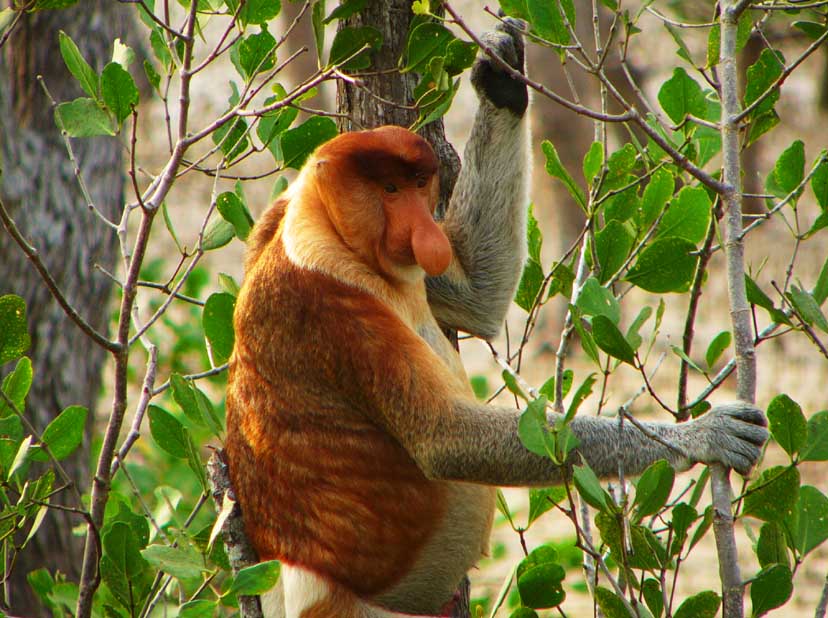
Bako is home to approximately 150 endangered proboscis monkeys, which are endemic to Borneo, and has been called "the best place to see proboscis monkeys in Sarawak".[3] Other animals include the long-tailed macaque, silvered langur, plantain squirrel, Bornean bearded pig, monitor lizards, and otters. All of these are present in the forest as well as near camp headquarters on Telok Assam beach. Bako is also home to a number of lizards and snakes, most of which are harmless. Bako is a fascinating place for bird watching, with over 150 species recorded. Bako's nocturnal creatures include the colugo, pangolin, mouse deer, various species of fruit eating and insect eating bats, tarsier, slow loris, and palm civet cat.


Thursday, April 2, 2009

Welcome to the Tracks,a great accomodation in Kuching,Sarawak.

TRACKS is a new modern concept of B & B at the heart of Kuching city center, in the ‘Golden Triangle’ area near the Kuching Waterfront, with walking distance to all historical and modern landmarks of tourist attractions and a perfect place for a hub of traveling around Kuching and the whole island of Borneo itself.

Clean, homely and comfortable environment at a very reasonable price, Tracks will make your stay in Kuching a memorable one. We understand the needs of travelers as we ourselves are travelers too.

We are glad to help you out if you need assistance or advice, since this B & B is runs by young generation Ibans with travel knowledge and experience of local customs.

Since you are on holidays, there is no curfew and no lockouts time. You can move in and out freely with our 24 hours keycard security access system.
Lets your footprint starts here!

The Management
Robinson Unau

OUR SERVICES


  • Laundry
  • Free Personal lockers & bags storage
  • Clean common hot & cold shower
  • Color LCD TV & satellite channel
  • DVD player & movies
  • WiFi Internet access
  • 24hours Security system (Card Access)
  • Tourist Information
  • No curfew & no lockouts times.

Room Types & Rates

TRACKS is a budget accommodation catering for those who are on 'shoe string' budget, but with a clean and cozy atmosphere yet affordable.
Dorms
Twin Dorms
Double Room (Air Conditioned)

  • ALL communal shower and toilets.
  • ALL prices are inclusive of breakfast, bed sheets and towels

CONTACT US


Tracks Bed & Breakfast
1st Floor,No. 5, Jalan Green Hill,
93100, Kuching, Sarawak, Eastern Malaysia.
Website: www.tracksbnb.com
Tel: (+6) 019-6407372 (mobile)