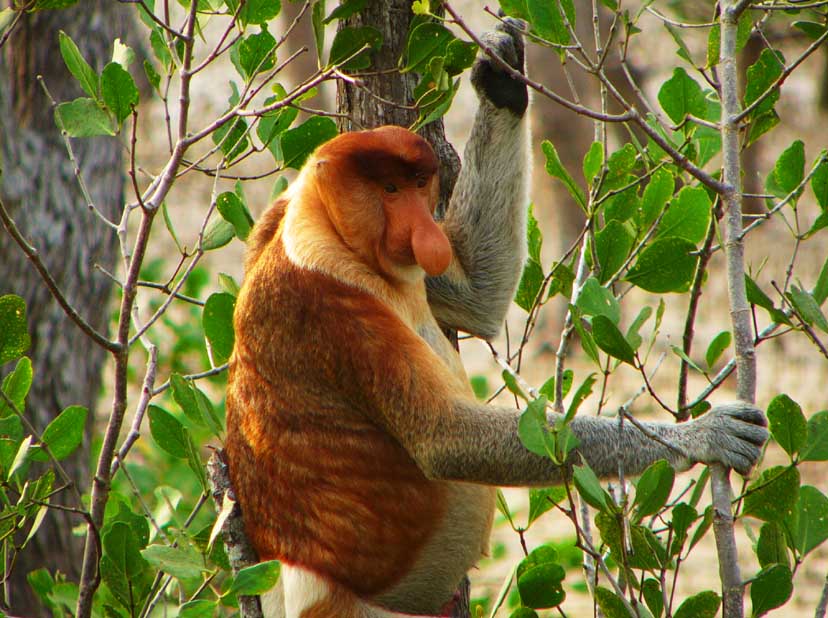
The
proboscis monkey (
Nasalis larvatus) or
long-nosed monkey, known as the
bekantan in
Malay, is a reddish-brown
arboreal Old World monkey that is
endemic to the
south-east Asian island of
Borneo. It belongs in the
monotypic genus
Nasalis, although the
pig-tailed langur has traditionally also been included in this genus – a treatment still preferred by some.
The monkey also goes by the Malay name
monyet belanda ("Dutch monkey"), or even
orang belanda ("Dutchman"), as Indonesians remarked that the
Dutch colonisers often had a similarly large belly and nose.
This
species of monkey is easily identifiable because of its unusually large nose.
Taxonomy
Proboscis monkeys belong to the
Colobinae subfamily of the
Old World monkeys. There are two subspecies:
- Nasalis larvatus larvatus (Wurmb, 1787), which occupies the whole range of the species;
- Nasalis larvatus orientalis (Chasen, 1940), restricted to north-east Kalimantan.
However, the difference between the subspecies is small, and not all authorities recognise
N. l. orientalis.
Physical description
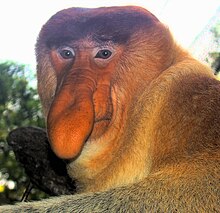
Closeup of a proboscis monkey face
The proboscis monkey is a large species, being one of the largest monkey species native to
Asia. Only the
Tibetan Macaque and a few of the
gray langurs can rival its size. There is pronounced
sexuality dimorphism
in the species. Males have a head-body length of 66 to 76.2 cm (26 to
30.0 in) and typically weigh 16 to 22.5 kg (35 to 50 lb), with a maximum
known weight of 30 kg (66 lb). Females measure 53.3 to 62 cm (21.0 to
24 in) in head-and-body length and weigh 7 to 12 kg (15 to 26 lb), with a
maximum known mass of 15 kg (33 lb). Further adding to the dimorphism is the large nose or
proboscis of the male, which can exceed 10 cm (3.9 in) in length
,and hangs lower than the mouth.
Nevertheless, the nose of the female is still fairly large for a
primate. The proboscis monkey has a nearly long coat. The fur on the
back is bright orange, reddish brown, yellowish brown or brick-red.The underfur is light-grey, yellowish, or greyish to light-orange.
The face is orange-pink. The male has a red penis with a black scrotum.
Both sexes have bulging stomachs that give the monkeys what resembles a
pot belly. Many of the monkey’s toes are webbed.
Behavior
Social behavior
Proboscis monkeys generally live in groups composed of one adult male, some adult females and their offspring
. All-male groups may also exist. There are some individuals that are solitary, most of which are males. Monkey groups leave in home ranges that overlap and there is little territoriality.Proboscis monkeys live in a
fission-fusion society,
with groups gathering at sleeping sites as night falls. There exist
bands which arise when groups come together and slipt apart. Groups gather during the day and travel together, but individuals only groom and play with those in their own group. One-male groups consist of 9–19 individuals while bands can consist of as many as 60 individuals. One-male groups typically consist of 3–12 individuals but can contain more. Serious aggression is uncommon among monkeys but minor aggression does commonly occur.Overall, members of the same bands are fairly tolerant of each other. A linear dominance hierarchy exists between females.
Male of one-male groups can stay in their groups for 6–8 years.
Replacements in the resident males appear to occur without serious
aggression. Upon reaching adulthood, males leave their natal groups and join all-male groups.
Females also sometimes leave their natal groups, perhaps to avoid
infanticide or inbreeding, reduce competition for food or elevation their social status.
Reproduction
Females become sexually mature at 5 years old. They experience
sexual swelling, which involves the genitals becoming pink or reddened. At one site, matings largely take place between February and November while births occur between March and May.
Copulations tend to last for half a minute. The male will grab the female by the ankles or torso and mount her from behind. Both sexes will encourage mating but they are not always successful.
When soliciting, both sexes will make a pouted face. In addition, males
will sometimes vocalize and females will present show their backsides. Mating pairs are sometimes harassed by sub-adults. Proboscis monkey may also engage in mounting with no reproductive
purpose, such as playful and same-sex mounting. Gestation usually last
166–200 days or slightly more.Female tend to give birth at night or in the early morning. The mother then eats the placenta and licks her infant clean. The young begin to eat solid foods at 6 weeks and are weaned at 7
months. The nose of a young male grows slowly until reaching adulthood.
The mother will allow other members of her group to hold her infant. When a resident male in a one-male groups is replaced, the infants are at risk of infanticide.
Communication
Proboscis monkey are known to make various vocalizations. When
communicating the status of group, male will emit honks. They have a
special honk emitted towards infants, which is also used for
reassurance. Males will also produce alarm calls to signal danger. Both
sexes give threat calls, but each are different. In addition females and
immature individuals will emit so called "female calls" when angry.
Honks, roars and snarls are made during low intensity agonistic
encounters. Non-vocal displays include leaping-branch shaking,
bare-teeth open mouth threats and erection in males, made in the same
situations.
Ecology
Range and habitat
The proboscis monkey is
endemic to the island of
Borneo and can be found on all three nations that divide the island: Brunei, Indonesia, and Malaysia. It is most common in coastal areas and along rivers. This species is restricted to lowland habitats that may experience tides.It favors
dipterocarp,
mangrove and
riverine forests. It can also be found in swamp forests, stunted swamp forests, rubber forests, rubber plantations, limestone hill forests,
nypa swamps,
nibong swamps, and tall swamp forests, tropical heath forests and steep cliffs.
This species usually stays at least a kilometer from a water source. It
is perhaps the most aquatic of the primates and is a fairly good
swimmer, capable of swimming up to 20 m (65.6 ft) underwater. It is
known to swim across rivers. Aside from this, the proboscis monkey is largely arboreal and moves quadrupedally and by leaps. It is known to jump off branches and descend into water.